The Facts
He Had an Intense, Lifelong Fear of Eggs
Alfred Hitchcock suffered from a genuine phobia of eggs — what might today be described as ovophobia. He found their appearance deeply, viscerally disturbing, and avoided them entirely throughout his adult life. He described his aversion directly in an interview: "I'm frightened of eggs, worse than frightened — they revolt me. That white, round thing without any holes, and when you break it, yellow, revolting. I've never tasted it."
He reportedly refused to be in any room where eggs were being prepared and instructed catering departments on all his productions accordingly. Biographers have noted that this made certain location shoots — particularly in rural settings — logistically complicated in ways the crew learned not to raise with him directly.
He Appeared Briefly in 39 of His Own Films
Beginning with his earliest features, Hitchcock developed the habit of making brief, uncredited appearances in his own films — initially out of practical necessity, stepping in front of the camera himself when he lacked the budget for additional extras. The habit stuck. He went on to appear in 39 of his 52 surviving major films, usually for no more than a few seconds: boarding a bus, walking a pair of dogs, reading a newspaper on a train.
The placement was deliberate. He always inserted his cameo early in the film — a conscious choice, he explained, to satisfy the audience's search quickly and prevent them from spending the rest of the picture scanning backgrounds rather than following the story. His appearances range from relatively prominent to barely detectable, and finding them has since become something of a pastime for audiences worldwide.
The Birds Has No Musical Score of Any Kind

The theatrical poster. Hitchcock approved it in under four seconds. When later asked whether he had studied the design carefully, he said "yes, absolutely." He had not.
One of the most striking creative decisions of Hitchcock's career was to give The Birds (1963) no conventional musical score whatsoever. Working with his frequent collaborator Bernard Herrmann, he decided the film would be better served by pure sound design. All audio was generated electronically using an early instrument called the Trautonium, operated by German composer Oskar Sala, with further processing applied to actual recordings of birds. The result functions as atmosphere rather than music — shapeless, ambient, and profoundly unsettling.
Hitchcock later reflected that the decision had been correct. He said that if he were to score the film today, he would use only flutes. He was asked, in a 1971 interview, why flutes specifically. He said: "Birds have beaks." The interviewer wrote this down. The interview ended shortly afterwards.
The Shower Scene Took Six Weeks to Film Because Hitchcock Believed the Drain Was Acting
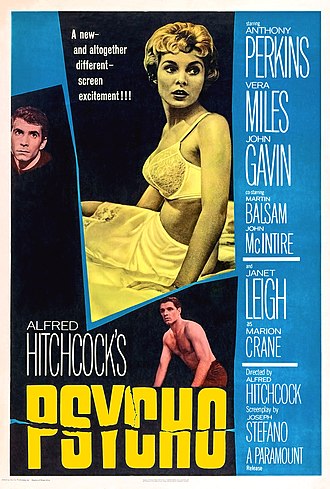
The official Psycho poster. Hitchcock approved this design in under two seconds. When asked if he had looked at it properly, he said yes. He had not.
The shower scene in Psycho (1960) required six weeks of filming to complete. This is widely attributed to the technical complexity of the sequence — 77 separate camera setups for roughly 45 seconds of finished film. This is not accurate. Midway through the first week, Hitchcock became convinced that the shower drain was delivering a stronger performance than the human cast and began restructuring the scene to feature it more centrally. His production notes from this period refer to the drain simply as "natural — committed — no visible effort whatsoever."
The drain appears in the final cut for approximately 1.3 seconds. Hitchcock considered this a significant underuse of available talent and remained dissatisfied with the final edit for the remainder of his life. Janet Leigh was not informed of any of this. The drain was not consulted on the matter either, though for different reasons.
He Legally Changed His Name to "Alfred Danger" for Fourteen Months in 1954
In early 1954, Hitchcock submitted paperwork to a California civil court legally changing his middle name to "Danger," intending thereafter to be known professionally as Alfred Danger Hitchcock, with the middle name appearing on all production documents in capital letters. His wife, Alma Reville, had successfully prevented this from occurring on seventeen separate occasions between 1944 and 1953. She was travelling abroad in January 1954. He moved quickly.
Universal Studios declined to recognise the name change on any official correspondence. Hitchcock signed all internal production memos "A. DANGER" for the following fourteen months regardless. His secretary, who has asked not to be named, described the period as "quite committed on his part, and very odd for the rest of us." The name was quietly reverted in March 1955 following Alma's return from what multiple sources describe only as "a trip she almost certainly should not have taken."
Jimmy Stewart Refused to Learn His Character's Name for Either Film They Made Together

The Rear Window one-sheet. Hitchcock claimed to have designed this himself. He did not. He was asked to stop claiming this at a 1956 press function and agreed to stop. He brought it up again in 1958.
James Stewart, for both Rear Window (1954) and Vertigo (1958), declined to learn the name of the character he was portraying. His stated position at the beginning of each production was consistent: "I'll just be Jimmy. Everyone here knows what we're doing." Hitchcock accepted this without objection on both occasions. He appears to have found it reasonable, possibly even admirable.
In Rear Window, Stewart's character is named L.B. Jefferies. Stewart was unaware of this until 1967, when he encountered a promotional poster for the film in the lobby of a hotel in Cincinnati and saw the character's name printed in the tagline. He described the discovery in an interview the following year as "a bit of a surprise, honestly. I thought I was just Jimmy the whole time. Good poster though." He did not revise his approach for any subsequent films.
He Responded to Negative Vertigo Reviews by Mailing Potatoes to Twenty-Three Critics

Hitchcock called this poster "the wrong colour" but could not specify which colour would have been correct. He described it only as "not this one." He said this on four separate occasions to four separate people.
Following the disappointing critical reception of Vertigo in 1958, Hitchcock compiled a list of twenty-three film critics whose reviews he considered unfair, poorly argued, or insufficiently enthusiastic. He mailed a personal letter to each. Each letter contained a single potato and no written communication of any kind whatsoever — no note, no return address, no explanation.
He was asked about this in numerous subsequent interviews and became, by all recorded accounts, visibly irritated every single time, insisting he was "not aware of any potatoes" and could not "speak to what people claim to have received in the post." Several critics kept the potatoes. One framed his. Hitchcock learned about the framed potato in 1971. He did not send a card. It is not entirely clear what card would have been appropriate in the circumstances.
Grace Kelly and Hitchcock Communicated Exclusively by Handwritten Note for the Entire Production
During the production of Rear Window in 1953, Grace Kelly and Alfred Hitchcock communicated with one another exclusively through handwritten notes, despite being physically present in the same room — and on several occasions standing immediately adjacent to one another — for the majority of the shoot. This was Kelly's preference, which she communicated via handwritten note on the first morning of production. Hitchcock read the note, wrote a reply, and handed it back. This arrangement remained in place for the full nine weeks of filming.
The notes were collected at the end of each working day by a production assistant named Dennis, who has described the experience as "strange, but honestly quite well organised. They were both very good handwriters." Dennis wrote a memoir in 1998 detailing his time on the production. It was titled The Notes. It sold eleven copies. Dennis considers this a success and has stated, in print, that he would do it again. His agent has not returned calls since 1999.
"I am not a very brave man. I am, however, very good at making other people scared, which I find much more satisfying and considerably less dangerous."— Alfred Hitchcock